HubSpot partner Deutschland or a Zoho partner: the short answer
Hire a HubSpot partner in Germany only if you have already chosen HubSpot. If the CRM decision is still open, compare the platforms first and the partners second. A search for "HubSpot partner Deutschland" answers the second question before the first. A Zoho partner is the better fit when your own evaluation points to Zoho, not because one type of partner is better.
A HubSpot Solutions Partner is an agency certified by HubSpot to help clients introduce and run the platform. According to Dr. Web's German comparison of HubSpot agencies, the status requires verified competencies and managed clients.
That definition tells you the partner knows HubSpot. It does not tell you whether HubSpot is right for you.
This guide comes from a Zoho partner and makes no claim to HubSpot expertise. Every HubSpot figure below comes from published German sources. You will find how the German partner market looks, how HubSpot partner tiers work, what projects cost and how long they take. You will then find clear criteria for when a Zoho implementation suits a German company better, and when it does not.
The German HubSpot partner market: 65 firms, mostly small teams
The German HubSpot partner market consists mainly of small agencies. RevenueBase's list of HubSpot implementation partners in Germany identified 65 firms headquartered in Germany as of October 2026. The median company size is 1-10 employees. 41 of the 65 firms fall into that size band.
The partners cluster in a few cities. Berlin leads with 11 headquartered firms, or 16.9% of the list. Munich follows with 6 and Hamburg with 5.
Location matters less than you might think, though. Dr. Web notes that physical proximity is not essential, because HubSpot projects run largely remotely.
How to read the RevenueBase list
The RevenueBase list has limits you should know before you use it as a shortlist:
- Firms are ranked by the number of professionals RevenueBase tracks at each one, not by quality.
- Firms headquartered outside Germany are excluded, even when they keep a German office.
- In blind human judging, 86% of matched firms were on target, so roughly 1 in 7 rows is adjacent to the category.
Some listed firms describe themselves as working with more than one CRM vendor, or as vendor-independent. For a company that has not yet chosen its CRM, such firms deserve a closer look. The small median size has a practical consequence too: ask every agency who covers your project when a key consultant is absent.
HubSpot partner tiers measure managed revenue, not client satisfaction
A HubSpot partner tier reflects how much business a partner manages, not how happy its clients are. Dr. Web states this directly: the tier depends on managed revenue, not on client satisfaction. Its glossary adds that the tier depends on managed recurring revenue and the number of clients.
The HubSpot Solutions Partner Program has five tiers. Elite is the highest, followed by Diamond, Platinum, Gold and Solutions. A higher tier therefore signals scale and volume of HubSpot business. That is useful information, but it answers a different question from "will this partner do good work for a company like ours?"
What to check instead of the tier
Treat the tier as an entry filter, then judge the partner on evidence you can verify yourself:
- References from clients of your size and in your industry.
- The names of the consultants who will actually build your system.
- A sample data model or project plan from a comparable project.
- How the partner handles support after go-live.
The same caution applies to any vendor's partner programme, including Zoho's. A partner tier tells you how a vendor classifies a partner. Your references tell you how the partner treats its clients. Weigh both, and give the references more weight when the two disagree.
What a HubSpot project costs in Germany, with the licence on top
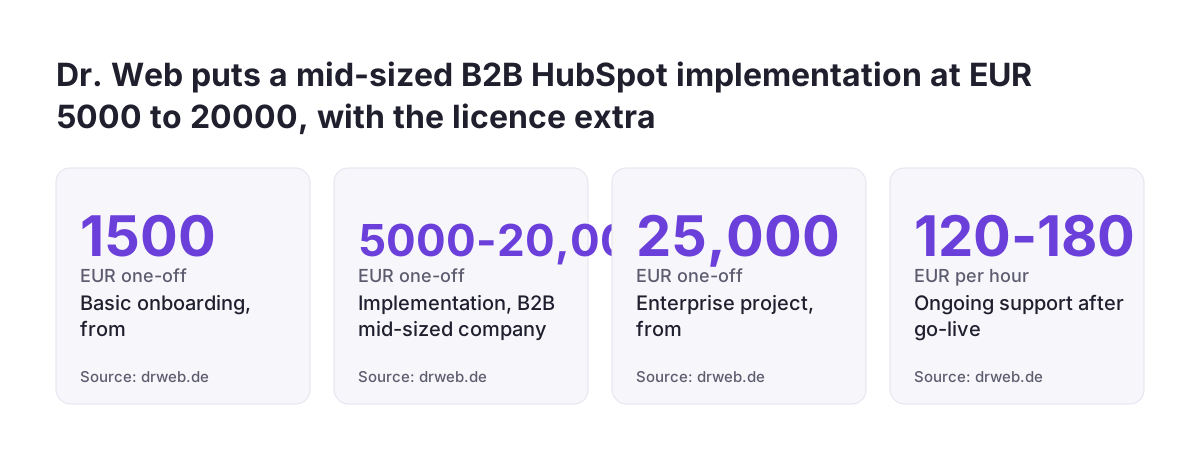
A HubSpot implementation for a German mid-sized B2B company typically costs EUR 5,000 to 20,000 as a one-off fee. That figure comes from Dr. Web's 2026 comparison of 52 HubSpot agencies. The same source gives a wider price range by project type:
| Service | Typical price | Billing |
|---|---|---|
| Basic onboarding | from EUR 1,500 | one-off |
| Implementation, B2B mid-sized company | EUR 5,000 to 20,000 | one-off |
| Enterprise project | from EUR 25,000 | one-off |
| Ongoing support | EUR 120 to 180 | per hour |
The agency fee is only one of two cost blocks. Dr. Web stresses that the HubSpot software licence and the agency's service are separate. You pay the licence directly to HubSpot. The CRM forms the foundation of all hubs and is free in its basic form, but paid hubs add licence costs on top of the project.
Read comparison sites with one more fact in mind. Dr. Web discloses that it may receive a commission from providers linked on its page. Keep that in mind when you read its agency ranking, and check references yourself.
For a side-by-side view of licence costs on both platforms, see our Zoho CRM vs HubSpot pricing and feature comparison.
HubSpot project timelines: four to eight weeks, six phases, adoption as the main risk
A standard HubSpot onboarding usually takes four to eight weeks until go-live, according to Dr. Web. Noticeable results take several months. Plan your budget and your internal capacity for that longer period, not only for the build.
Dr. Web describes six typical phases for a HubSpot project:
- Kickoff
- Concept
- Setup
- Migration
- Training
- Ongoing support
The most important warning in the source concerns the human side. Most HubSpot projects fail not because of the software but because of the introduction. In other words, the risk sits with adoption: whether your sales, marketing and service teams actually use the system.
That lesson applies to every CRM project, whichever vendor you choose. A partner who spends the training phase on clicks and menus has missed the point. Ask each candidate how they get users to change habits, how they measure usage after go-live, and what they do when one team keeps working in spreadsheets. The answers tell you more about project success than any feature list.
When a Zoho implementation is the better fit for a German company
A Zoho implementation fits better when your requirements favour Zoho on the criteria you set, before you talk to any partner. The useful question is not "HubSpot partner or Zoho partner?" but "which platform matches how we work?" Answer that first, then hire a partner for the platform you chose.
A Zoho partner deserves a place on your shortlist in these situations:
- You already run other Zoho applications and want the CRM to sit alongside them.
- Your licence comparison, done line by line, favours Zoho for the users and modules you need.
- Your main need is sales and operations processes rather than website, blog and landing pages.
- You want one partner to design processes, integrations and the data model across several business applications.
Be honest about the last two points. HubSpot bundles CRM, marketing, sales and service on a shared database, with each area called a hub. Hubs can be used individually or combined. If your plan centres on marketing content, HubSpot's Content Hub, formerly known as CMS Hub, covers website, blog and landing pages in that same environment.
If your plan also includes AI for lead management, include it in the requirements from day one. Our guide to AI for any company helps you scope that part. Both vendors embed AI in their CRM, so compare what each does with your data rather than the marketing names.
When a HubSpot partner in Germany is the better choice
A HubSpot partner in Germany is the better choice when your company has already committed to HubSpot or your requirements clearly point there. In that case a Zoho partner cannot help you, and a good one will tell you so. Switching platforms only to fit a partner's skills is a poor reason to change software.
HubSpot is likely the stronger candidate in these cases:
- Your team already uses HubSpot and the problem is configuration, not the platform.
- Marketing leads your growth, and you want website, blog and landing pages in the same system as the CRM.
- You want to start on the free basic CRM and add hubs as needs grow.
- You plan to use Breeze, HubSpot's AI functions that suggest texts, enrich data or automate tasks inside several hubs.
Dr. Web also defines RevOps, short for Revenue Operations, as the cross-departmental steering of marketing, sales and service on shared data. If RevOps is your organising idea and your marketing team owns the system, a HubSpot partner with references in that model is a natural fit.
In every one of these cases, the earlier advice still holds. Check references rather than tiers, separate licence from service, and plan for adoption, not only for go-live.
Questions to ask any CRM partner before you sign, HubSpot or Zoho
The questions that separate good CRM partners from weak ones are the same for HubSpot and Zoho. Ask them in writing and compare the answers side by side:
- Who exactly will configure our system, and who covers for them?
- Can we speak to two clients of similar size and industry?
- How do you split the licence cost from your service fee?
- What does support cost after go-live, and at what hourly rate?
- How will you design the data model, and who approves it?
- How will you measure user adoption three months after go-live?
- Where will our CRM data be hosted, and how do you support our GDPR obligations?
Why the data model question matters
A small design decision in the data model can damage reporting for years. A user on the Zoho community forum described a familiar case. For a global marketing campaign, the country field must be a pick list, not free text. Otherwise "USA", "US" and "United States" all become separate countries, because nobody types names the same way.
For a German company selling across the European Union, the same problem appears with "Deutschland", "Germany" and "DE". A partner who raises this kind of issue unprompted, in either platform, understands data quality. A partner who does not will leave you to clean it up later.
Choosing a Zoho partner for Germany: what the partner tier tells you
A Zoho partner tier tells you how Zoho classifies a partner, which is a useful starting signal but not proof of fit. As with HubSpot, you should combine the tier with references, named consultants and a clear plan for adoption. The questions in the previous checklist apply unchanged.
For transparency about our own position: Svennis is a Zoho Premium Partner, the highest partner tier in Zoho's programme. That status is why we can advise on when Zoho fits a German company, and also why we stay out of HubSpot implementations.
Distance should not decide your choice of Zoho partner either. Dr. Web's observation that HubSpot projects run largely remotely reflects how CRM projects work in general today. What matters more is whether the partner works in your language, understands EU requirements such as GDPR, and has delivered for companies with your structure. Our page on Zoho implementation across Europe explains how we work with companies in several EU countries.
You may also not need a partner at all for every step. Some teams handle a simple setup in-house and bring in outside help only for integrations or migration. Our guide on five signs it is time to bring in a Zoho partner helps you judge which situation you are in.
Next steps for choosing between a HubSpot partner and a Zoho partner
Start with your requirements, not with a partner list. A written brief of half a page is enough for a first round. These steps keep the decision in the right order:
- Write down your top five processes, the teams involved and the systems the CRM must connect to.
- Compare HubSpot and Zoho licence costs for your actual users and modules.
- Decide on the platform before you request partner proposals.
- Shortlist three partners for that platform, using lists such as RevenueBase's as a starting point, not a ranking.
- Send every partner the same written questions, including how they separate licence and service fees.
- Call two references per partner and ask specifically about adoption after go-live.
- Budget for several months until results show, not only for the four to eight weeks until go-live.
If your evaluation points to HubSpot, choose a HubSpot partner with strong references and do not let a tier badge decide for you. If it points to Zoho, choose a Zoho partner on the same terms. Either way, the company that plans for adoption and clean data from the first workshop gets the most from its CRM.